
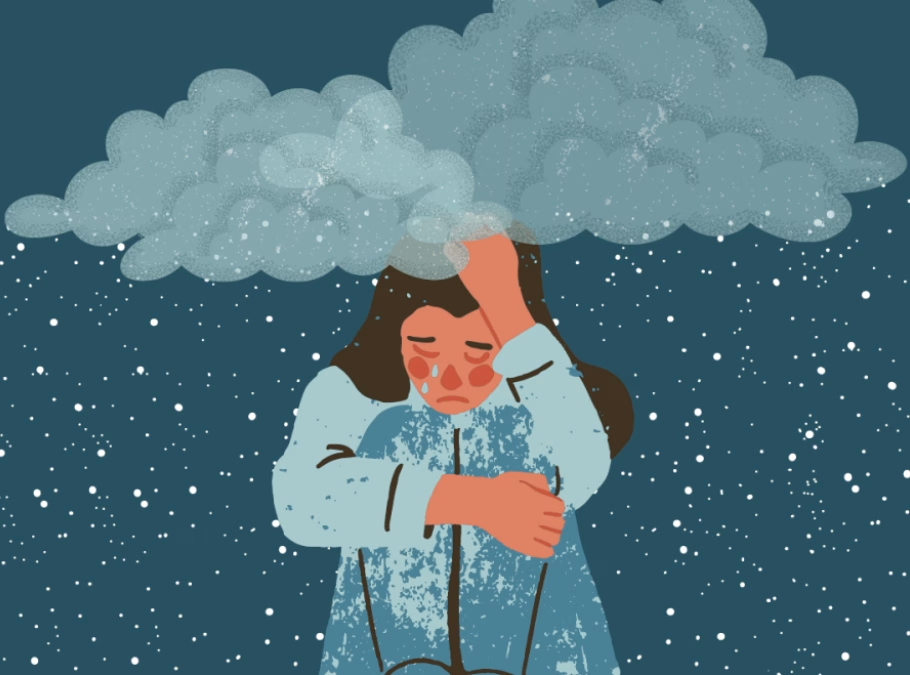
There is something that happens in the shift from March into April, when Melbourne’s afternoons start shortening, and the air carries that unmistakable cool edge. For many people, it is just a seasonal change. For others, something heavier begins to settle: a low-grade tiredness that wasn’t there in summer, a withdrawal from things that usually bring pleasure, a heaviness that is difficult to name but impossible to ignore.
If you grew up in Latin America, or anywhere the sun is a constant companion rather than a seasonal visitor, this shift can feel particularly disorienting. Nobody warned you about this. The loss of light is not just meteorological. For your nervous system, it may register as something closer to grief.
If you are seeing yourself in those words, this article is for you. It explores what seasonal depression actually is, why immigrant women from sun-rich countries are particularly vulnerable to it, and what you can do as autumn deepens and winter approaches.
What Is Seasonal Affective Disorder?
Seasonal Affective Disorder, or SAD, is a recognised subtype of major depression that follows a predictable seasonal pattern. Most commonly it emerges in late autumn and deepens through winter, then remits in spring and summer. It is not simply “winter blues” or the ordinary fatigue of shorter days. Clinically, it meets the same criteria as a depressive episode: persistent low mood, loss of interest in activities, changes in sleep and appetite, fatigue, difficulty concentrating, and a pervasive sense of hopelessness (DSM-5).
The biology behind it is well understood. Reduced sunlight in autumn and winter triggers a cascade of neurochemical changes. Serotonin production, which regulates mood and is stimulated by light, drops as daylight hours shorten. Simultaneously, the brain produces more melatonin, the hormone associated with sleep and darkness, creating an extended biochemical signal of “night” that can dysregulate mood, energy, and appetite (PMC, 2010; Rybakowski, 2024). The body’s internal clock shifts out of sync with the external world, and for people with a biological sensitivity to these changes, the result is depression with a seasonal face.
SAD is diagnosed significantly more often in women than in men, with reported ratios ranging from two to one up to nine to one in some studies (Melrose, 2015). Research suggests this may be partly due to differences in how women’s melatonin secretion responds to seasonal changes in daylight, creating a hormonal mechanism that leaves women more neurobiologically exposed to the impact of winter (NIH, cited in Melrose, 2015). The higher rates of depression in women more broadly, documented consistently across cultures and attributed to a complex interaction of biological, hormonal, and social factors (Seedat et al., 2009), further compound this vulnerability.
Why This Hits Differently If You Came From Somewhere Warm
Here is what the research tells us, and what many immigrant women already know viscerally: moving from a tropical or subtropical country to a high-latitude environment is a significant and often underestimated risk factor for seasonal depression.
A recent systematic review and meta-analysis found that higher latitude is significantly associated with increased prevalence of SAD, with evidence for the role of seasonal light variation in the pathogenesis of winter-pattern depressive disorders. In other words: the further from the equator you live, the more pronounced the seasonal shifts in light become, and the more significant their neurological impact.
For someone raised in a country with minimal seasonal variation in sunlight, this is doubly disorienting. Your nervous system developed in a light environment that was relatively stable across the calendar year. The dramatic reduction in light that Melbourne’s winters bring, with grey skies, shortened days, and a sun that often fails to appear for days at a time, is genuinely novel for your biology. Research examining SAD in immigrant populations notes that factors such as migration, acculturation, climate change, and shifts in social networks all interact with the disorder’s onset and progression, creating a particularly complex vulnerability for those who have moved from warmer regions.
Research on seasonal affective disorder among immigrant populations remains scarce, but the available studies consistently document that immigrants from tropical and subtropical regions experience significant challenges when adapting to high-latitude seasonal patterns, with ethnic and cultural differences observed in both prevalence and symptom expression.
There is also something that the research data cannot fully capture: the way that winter in your adopted country can activate a particular quality of longing. The grey sky is not just a weather event. It is also the absence of the light that meant home. For Brazilian women living in Melbourne, a cold Tuesday in June is not emotionally neutral. It may carry the ghost of a Copacabana summer, a family lunch on a sunny terrace, warmth that was relational as well as meteorological. This emotional layer sits on top of the neurobiological one, and the two amplify each other in ways that are real, clinically meaningful, and worth attending to.
Recognising the Signs
Part of what makes seasonal depression particularly insidious is how easily it is misread. You may attribute the fatigue to being busy. The withdrawal from social life may feel like introversion. The craving for carbohydrates and the weight gain that often accompanies winter SAD can trigger shame rather than curiosity. The low motivation may be labelled as laziness, in your own internal voice or in the cultural messaging around productivity.
Common signs of SAD to watch for as autumn progresses include:
- Persistent low mood or emotional flatness that is noticeably different from how you feel in summer.
- A loss of interest or pleasure in things that usually matter to you.
- Increased need for sleep combined with fatigue that sleep doesn’t resolve.
- Significant changes in appetite, particularly cravings for starchy or sweet foods.
- Difficulty concentrating, making decisions, or completing tasks.
- A sense of withdrawal from people, even those you care about.
- Feelings of hopelessness, worthlessness, or an inner heaviness that is hard to explain to others (Mayo Clinic, 2024).
It is also worth knowing that SAD can emerge alongside other conditions: anxiety, burnout, and eating difficulties all have documented associations with seasonal depression (Melrose, 2015). For immigrant women who are already managing the chronic stress of acculturation, the additional biological load of winter can tip a fragile equilibrium.
What Can Help: The Evidence
There are several approaches with strong evidence behind them, and the most effective strategies typically combine more than one.
Light therapy is the most established treatment for SAD. Daily exposure to a bright light lamp (10,000 lux, typically for 20 to 30 minutes each morning) mimics the effect of sunlight on the brain’s serotonin and melatonin systems and has been shown to be highly effective for winter-pattern depression (Melrose, 2015; Pfizer, 2025). A quality SAD lamp can be purchased online and is a reasonable first investment if you notice a consistent pattern of low mood each winter.
Vitamin D supplementation is worth discussing with your GP. Research suggests that vitamin D plays a role in regulating both serotonin and melatonin, and that low vitamin D levels may exacerbate the effects of SAD (Pfizer, 2025). People who grew up in sun-rich countries and now live at higher latitudes are at particular risk of deficiency, as their baseline exposure drops dramatically.
Physical movement outdoors, even on overcast days, supports circadian rhythm regulation and has documented mood benefits. A systematic review found that lifestyle modifications, including outdoor exercise, were consistently associated with improvements in SAD symptoms (Rothenberg et al., 2024).
Social connection and community matter significantly. Research has observed that being in a community and maintaining socialising activities, alongside exercise and being outdoors, provides meaningful benefits for those experiencing SAD. For immigrant women whose social networks are smaller or more fragile than they were in their home country, this recommendation carries particular weight. It may be the year to invest in that community you have been meaning to find.
Psychotherapy, particularly relational and depth-oriented work, offers something that the other interventions do not: a space to sit with the emotional meaning of winter for you specifically. The loss of light is not just biochemical. It is also the loss of warmth in its wider sense, of ease, of belonging, of the version of yourself who existed in another country, in another climate, in another life. Therapy creates room for that grief to be witnessed rather than suppressed, which has its own healing function.
An Intersectional Note
It would be incomplete to discuss seasonal depression in immigrant women without naming the broader context. You are not just a body responding to reduced light. You are a woman navigating life far from everything familiar, carrying the mental load of adaptation, managing relationships across time zones, possibly working in a language that is not fully yours, and doing all of this without the informal support systems that would have cushioned you at home.
Each of these stressors has a documented neurobiological cost. Chronic stress elevates cortisol and suppresses serotonin, creating a biological environment that mirrors and amplifies the effects of seasonal light loss. Loneliness, which research consistently identifies as one of the most significant risk factors for depression, is also disproportionately experienced by immigrant women in their first years in a new country (Guerrero et al., 2023).
When winter comes and you feel yourself going under, it is not weakness. It is the convergence of biology, climate, grief, and circumstance. All of it is real. None of it is your fault. And all of it is workable.
Preparing Now, While There Is Still Light
The most important thing about seasonal depression is that it responds well to early intervention. The time to prepare is now, in the beginning of winter, before the darkest months arrive.
Consider getting a light therapy lamp before you feel you need it. Book a blood test to check your vitamin D levels. Protect your exercise routine through winter rather than allowing it to be the first thing that falls away. Reach out to a friend or two and make plans that will pull you out of isolation during the grey months. Notice, as February becomes March, and then April, whether the season is beginning to affect you.
And if you have been through winters before in Melbourne and recognised yourself in any of what this article describes, please take that recognition seriously. Seasonal depression is not something to wait out alone. It is a clinical condition with effective treatments, and asking for support is exactly the right response.
If you are entering winter and already feel the weight beginning to settle, we invite you to reach out. Talking Works Psychology offers a space where all of this can be held. Book a session through clicking here and let’s begin before winter deepens.
References
DSM-5. (2013). Diagnostic and Statistical Manual of Mental Disorders (5th ed.). American Psychiatric Association.
Guerrero, N., et al. (2023). Barriers and facilitators to seeking and accessing mental health support among female migrants in Europe. BMC Women’s Health. https://pmc.ncbi.nlm.nih.gov/articles/PMC10523615/
Mayo Clinic. (2024). Seasonal affective disorder: Symptoms and causes. https://www.mayoclinic.org/diseases-conditions/seasonal-affective-disorder/symptoms-causes/syc-20364651
Melrose, S. (2015). Seasonal affective disorder: An overview of assessment and treatment approaches. Depression Research and Treatment. https://www.ncbi.nlm.nih.gov/pmc/articles/PMC4673349/
National Institutes of Health / PMC. (2010). Seasonal affective disorder: An overview and update. https://pmc.ncbi.nlm.nih.gov/articles/PMC3004726
Pfizer. (2025). Seasonal affective disorder: The science of SAD. https://www.pfizer.com/news/announcements/seasonal-affective-disorder-science-sad
Rothenberg, M., et al. (2024). Lifestyle modification as intervention for seasonal affective disorder: A systematic review. Journal of Psychiatric Research, 174, 209–219. https://doi.org/10.1016/j.jpsychires.2024.03.053
Rybakowski, J. (2024). Forty years of seasonal affective disorder. Psychiatria Polska, 58(5), 747–759. https://pubmed.ncbi.nlm.nih.gov/39863986/
Saheer, T. B., et al. (2013). Ethnic differences in seasonal affective disorder and associated factors among five immigrant groups in Norway. Journal of Affective Disorders, 151(1), 237–242. https://doi.org/10.1016/j.jad.2013.05.086
Seedat, S., et al. (2009). Cross-national associations between gender and mental disorders in the WHO World Mental Health surveys. Archives of General Psychiatry, 66(7), 785–795.
Stewart, A. E., et al. (2014). Possible contributions of skin pigmentation and vitamin D in a polyfactorial model of seasonal affective disorder. Medical Hypotheses, 83(5), 517–525.
World Health Organisation. (2024). Influence of seasonal affective disorder on immigrant populations. OMICS International. https://www.omicsonline.org/pdfdownload.php?download=open-access-pdfs/influence-of-seasonal-affective-disorder-on-immigrant-populations.pdf&aid=134936
Recent Comments